
fishing • scouting
To Learn the River, Know Thyself
June 10, 2026
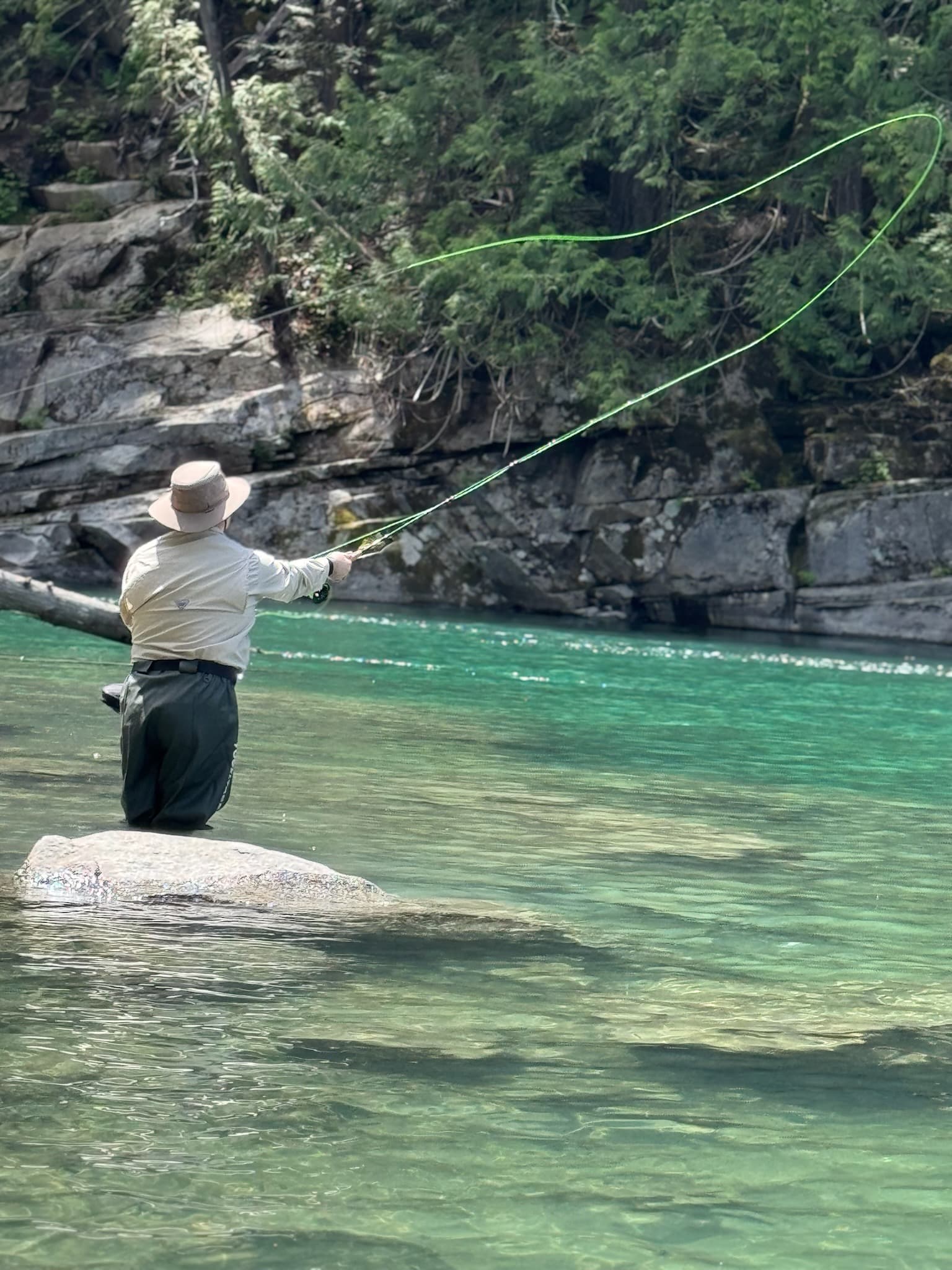
Last week my wife and I traveled to Seattle for vacation to visit my wife's brother and sister-in-law. While there, we decided to spend a few days by ourselves in the Cascades. We stayed in an Airbnb right on the Skykomish River and although that particular section of the river wasn't open to fishing while we were there, I was determined to spend some time on the water.
I had fly-fished ponds and lakes in Colorado, but I had aspirations to fish mountain rivers and clear glacier streams, in true "A River Runs Through It" style. I may have even had dreams of catching a rainbow trout, bringing it back to the Airbnb, and grilling it for dinner. I purchased my non-resident Washington fishing license and did some e-scouting for a place that I thought would be accessible and open for fishing. I found a spot upstream of Sunset Falls on the South Fork of the Skykomish that had a nearby pull-off where I could park.
After arriving and scouting the access to make sure it would be manageable to get down to the river, I lugged my gear down the bank. The area was pretty rocky, and being just downstream of Eagle Falls, the water was slow and the river was wide, almost like a small lake. It was also deep enough with dropoffs that a couple of teenagers had swum across the lake and were cliff diving into the frigid water.
I put my waders on, assembled my rod, and tied on a woolly bugger - a generalist fly that would probably be a good fly for scoping things out. Due to the dropoffs, I wasn't able to wade very far and with it being rocky, it wasn't easy to move around and reposition. With the water being so slow, there really wasn't any point in doing anything other than traditional casts and strips. Additionally, the water was pretty clear and I couldn't see any fish anywhere in the vicinity. After only an hour or so, I called it quits and drove back to the Airbnb.
Once there, I had the idea to spend the afternoon scouting new locations to fish for the following day as that was supposed to really be my full day of fishing. I found several spots while e-scouting that I thought would have potential, but I wanted to check them out first before committing to a spot for the following day.
I got back in the car and drove over to Proctor Creek, which was open and dumped into the Skykomish just downstream of the Airbnb. It was fairly shallow and clear, so I had a hard time imagining there being much fish in it. I mentally cataloged it as a potential back-up spot, but not my first choice.
Next I drove to the Big Eddy Public Access Area near Gold Bar, WA. While that section of the Skykomish was also closed, Crystal Creek supposedly dumped into the river near there and was open for fishing. After climbing a railroad embankment and still not finding the creek, I decided if it was there, access would be more frustrating than worth it.
I then drove back up Route 2 to Baring, where a public road just grazes the bank of an open section of the Skykomish. The area was surrounded by private property and there was a concrete barrier that would have to be crossed, followed by a steep scramble down to the bank - yet another location to cross off the list.
The last location I decided to try was Money Creek Campground further up Route 2. Pulling in, I could tell this spot had potential. There was a day use area with river access and many of the campsites were right above the water with scrambles down to the water that didn't look too treacherous. Logging the campground as the best place to start the following morning, I headed back to the Airbnb, happy with the results of my afternoon of getting my steps in to see the situation on the ground rather than just relying on e-scouting and hoping for the best.
The following morning, I drove to the Money Creek Campground, getting there around 9:30 am. I paid the day-use fee, collected my fly rod, waders, and backpack from the trunk of the car that contained my ruler mat, fillet knife, and net. I walked down the river access trail to the beach. Pulling on my waders and getting my rod ready, I already knew that this would be a better experience. The water was moving, and the bank was more sandy than rocky, potentially making it easier to relocate, which I did several times. I was able to practice cross-body roll casts, letting the fly float downstream, and then rolling upstream to place the fly back to my right. This meant less casting overall and used less energy. I decided to swap the woolly bugger for a white deep minnow, and found that with the lighter weight fly that didn't get quite as water-logged as the woolly bugger, it was easier and more accurate to cast. Having worked my way around the bend to some rapids, I spent some time targeting soft water behind rocks and casting in front of rocks to let the fly float past the soft water. I eventually moved back to the main portion of the day use area, where the beach was sandy and shallower and I could get farther into the more slowly moving water. After about three hours total, I called it and met my wife for lunch at a deli shop up Route 2.
Wanting to make the most of my three-day fishing license, I decided to try Proctor Creek in the late afternoon, despite initially crossing it off my list. I got there around 6 pm and walking upstream in my waders, I noticed that the water was deeper in spots than I had first thought. With the majority of stream being shallow and not particularly wide, though, I decided that a lighter fly that could be placed accurately with less line would be ideal. I tied on a zebra midge and found a couple spots under some low hanging branches and some slow moving deeper spots to try and target. As anticipated, the small zebra midge made handling the line nearly effortless. In fact, I could place the fly where I wanted it and after it would float four or five feet downstream, a quick flick of the rod vertical (not even a full cast) would reset the fly to where I wanted it. At one point though, my fly got caught on something and after applying too much force to free it, my leader came back empty - I had lost my midge.
Tying on the white minnow from earlier in the day, I moved further upstream and found some additional deeper spots to target. I practiced true upstream roll casting - using a traditional cast to put the fly where I wanted and as it floated back to me, I would slowly raise my rod behind at the same rate in order to let the D-loop forming behind me take up the slack in the line to keep a small amount of tension on the line to allow me to set the hook if needed. Then, with a quick forward and slightly downward motion, I would send the line rolling upstream in front of me to reset the fly to its original target.
With the sun sinking low and no fish on the line, I headed back to the Airbnb. The strange thing was that despite putting in more hours on the water and still coming back with no fish, I wasn't disappointed like I had been the day before. It had been a much better and much longer fishing experience, and I began reflecting on the days to try and figure out why.
The first thing I realized was that it felt good to see that my scouting work had been worth it - even though I hadn't caught anything, getting on the ground and crossing off hard to access locations meant that I wouldn't show up and get frustrated simply trying to get to the water.
The other interesting thing was that despite the second day being more effort, I came away with no fish and yet felt more accomplished, which meant that the disappointment of the previous day wasn't tied to a successful catch. Since the results had been the same, it dawned on me that it must have been the experiences themselves that were different. The first day's location had been rocky and the hard to navigate bank didn't allow for much movement, meaning I was relegated to one particular spot, casting the same way to the same stagnant water over and over again. Whereas the second day had seen much more movement, different parts of the river bend, and even different river bottom terrain, with shallower and deeper spots, slower and faster spots, and more seams and features to target.
And that's when the second big realization hit me. The difference was in the way that I had been allowed to interact with the water and engage with the landscape. Being active, exploring, trying new things, and solving micro puzzles (e.g. "How do I place a fly behind that rock given the swift current and bank foliage behind me?"), are what made the second day a much more enjoyable experience. For me, it isn't about merely participating - it's that even if the fish never bite, I want to be able to leave knowing I read the water, learned the river, and engaged with it on my terms. So, while I did learn a lot about those sections of water over the course of two days, I learned something more important about myself.