
hunting • rifles • family
.35 Remington Hog Notes
May 16, 2026
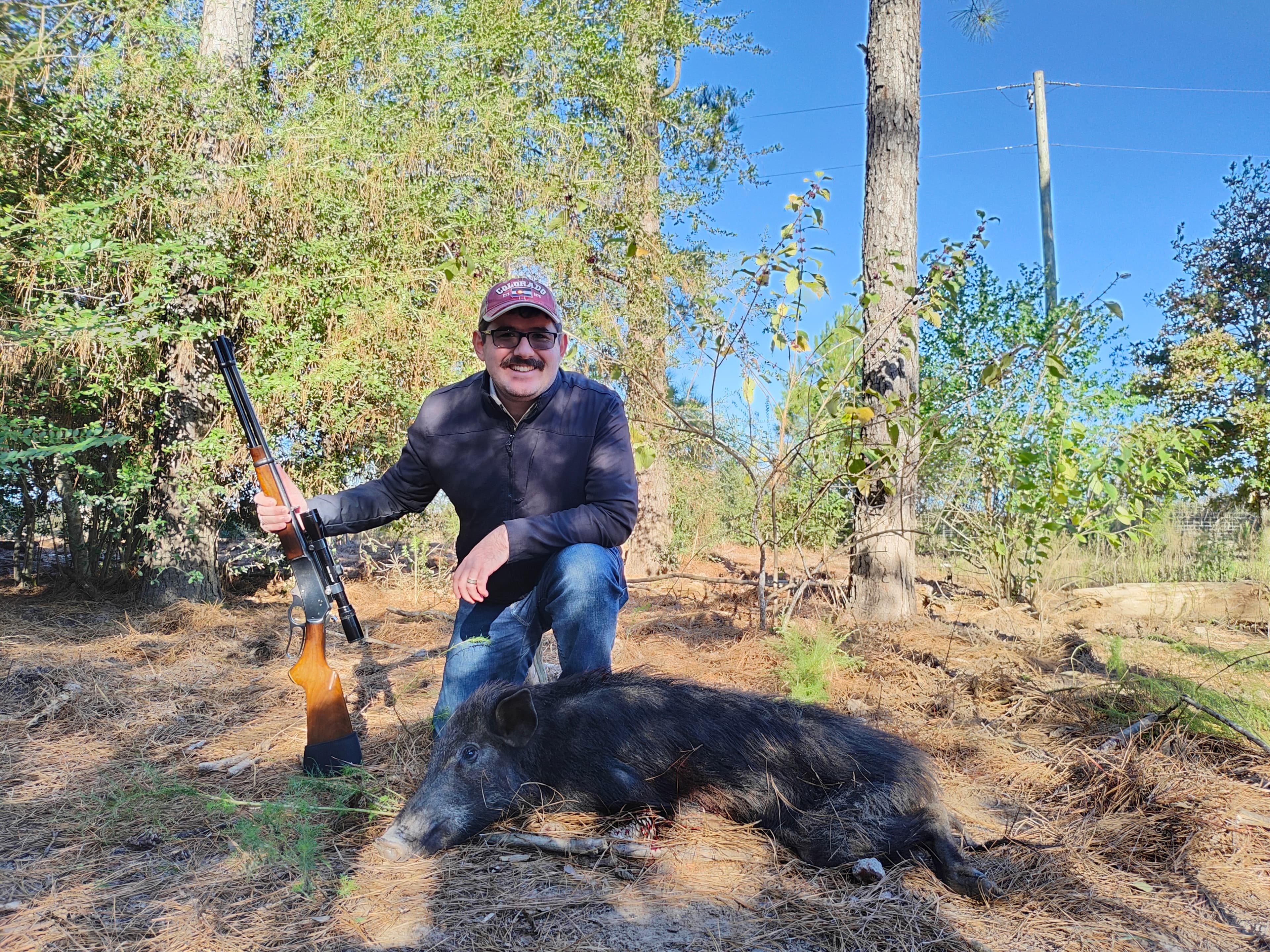
I’ve spent a fair amount of time thinking about rifle choice lately, especially when it comes to hog hunting. I think that we sometimes get caught up in the marketing hype and think that more firepower is always better than less firepower. I myself am guilty of this and have gone down research rabbit holes looking to up-level perfectly adequate hunting setups just because I can. At least for me, I have come to realize that reasonable hunting tools used in the proper context are more than adequate for most hunting situations.
Case in point being a hog hunt I went on last fall in the Piney Woods of East Texas when I brought my late grandpa's Marlin 336 chambered in the niche .35 Remington. While sitting in a blind under a canopy of loblolly pines waiting for hogs to pass by, I noticed a handful of spent cartridges of various calibers lined up on the wood shelf on the side of the blind, presumably left by previous hunters who hunted the same blind I was myself sitting in. I curiously picked a couple to see what people were using. As you would expect, there were a handful of very common .223 Remington, .300 BLK, and .308 Win cases. But one I picked up caught my attention - the headstamp read .300 Win Mag. I grinned and thought to myself, "Who is shooting 80 lb hogs with a .300 Win Mag?" Don't get me wrong - I am all for hunting with the tools you have and am by no means judging that individual - I just thought it was an interesting choice and perhaps a little overkill for the application.
Later in the morning, after not seeing anything at the blind, the hunting guide I was with suggested we shift to spot-and-stalk to increase our chance of success. Before long we stumbled across a fairly large sounder and after following them for a ways, they finally stopped about 30 yards away under a low hanging tree long enough to get on the shooting tripod, get my crosshairs on a 70 lb sow that was slightly quartering away, bring the hammer back to full-cock, and squeeze off a round of Hornady's Leverevolution ammo with the 200-grain FTX bullet suited for tubular magazines. The shot entered about 3/4 of the way back on the left lung and came out the front right shoulder, leaving a golf ball sized exit wound. The sow ran no more than 10 ft before dropping and by the time we had walked the 30 yards to the hog, it was dead.
While I had shot my grandpa's .35 Remington with him, this was my first time hunting with it and I was immediately a fan. I remember the first time he brought out the rifle for me to shoot when I was a teenager. When I asked what type of gun it was, he simply said, "This? This is a hog gun." Hunting hogs with his hog rifle was a special moment for me and I felt connected to him in a new way, despite his absence.
More recently, I was hunting hogs with my dad in a blind - he was using the .35 Remington and I had my Henry H9 Provider in .360 Buckhammer - and I watched my dad instantly drop a 160 lb sow with a textbook double lung shot at 50 yards with one of my .35 Remington handloads that uses Hornady 200-grain FTX bullets and Leverevolution powder.
While the comparable .30-30 is widely more popular and more readily available, the .35 Remington does provide a noticeable step up in amount of "thump" it delivers on game due to heavier bullet weights and a 16% larger bullet frontal area. As a result, the .35 Remington is a great woods and brush cartridge for typical woods hunting distances. It's no wonder that the .35 Remington has developed such a cult following - it's a hard hitting, mild recoiling woods cartridge and is chambered in easy carrying and handy lever action rifles. Are there more powerful, flatter shooting cartridges out there? Absolutely. But when I go into the woods, having my grandpa’s Marlin 336 in .35 Remington will be just fine for me.