
hunting • rifles
Aoudad Ergonomics
October 23, 2026
Being a west Texas native, I have always been fascinated with the Big Bend area and I dream of one day hunting big game out there. Last December a friend and I traveled out to the family property south of Alpine in Brewster County, TX. I have written about a couple of my experiences there in "Evening on the Creek in Brewster County" and "Chasing Scaled Quail in the Desert." And while we were out there in the middle of mule deer season, we unfortunately didn't end up seeing any. One of the things I didn't mention in those pieces, though, was an encounter we had with a different west Texas species.
Since we were hoping to spot a mule deer, we kept our eyes peeled for deer signs. We saw the obvious animal tracks - coyotes, jackrabbits, birds - but what was intriguing was that we kept seeing tracks all over the property (along the road, down in Terlingua creek, even way up in the canyon) that we couldn't identify. I could tell they definitely weren't deer tracks or javelina, but never having seen tracks like this before, it became an ongoing quandary - that is, until it wasn't.
On our 2nd full day at the property, we spent most of the morning hiking. After a sandwich lunch, we decided to head up Hwy 118 to a convenience store to get a few things, including more ice for the coolers. The property sits down in a basin that serves as a watershed for Terlingua Creek. We were driving along the dirt road off the property, almost to the point where the road started climbing up out of the basin, when my friend suddenly instructed me to stop. Before I could ask what was wrong, his hand shot out and he directed me to look at the basin wall sloping back up to the greasewood flats. Scrambling up the side of the basin were three brown animals that from that distance looked like some kind of goat. My friend thought they might be bighorn sheep, but I was slightly skeptical since they typically prefer higher elevations and because their numbers, while increasing, are low in Texas. I dug my monocular out of my pack, adjusted the focus to get a clearer image, and discovered three large aoudad looking down at us.
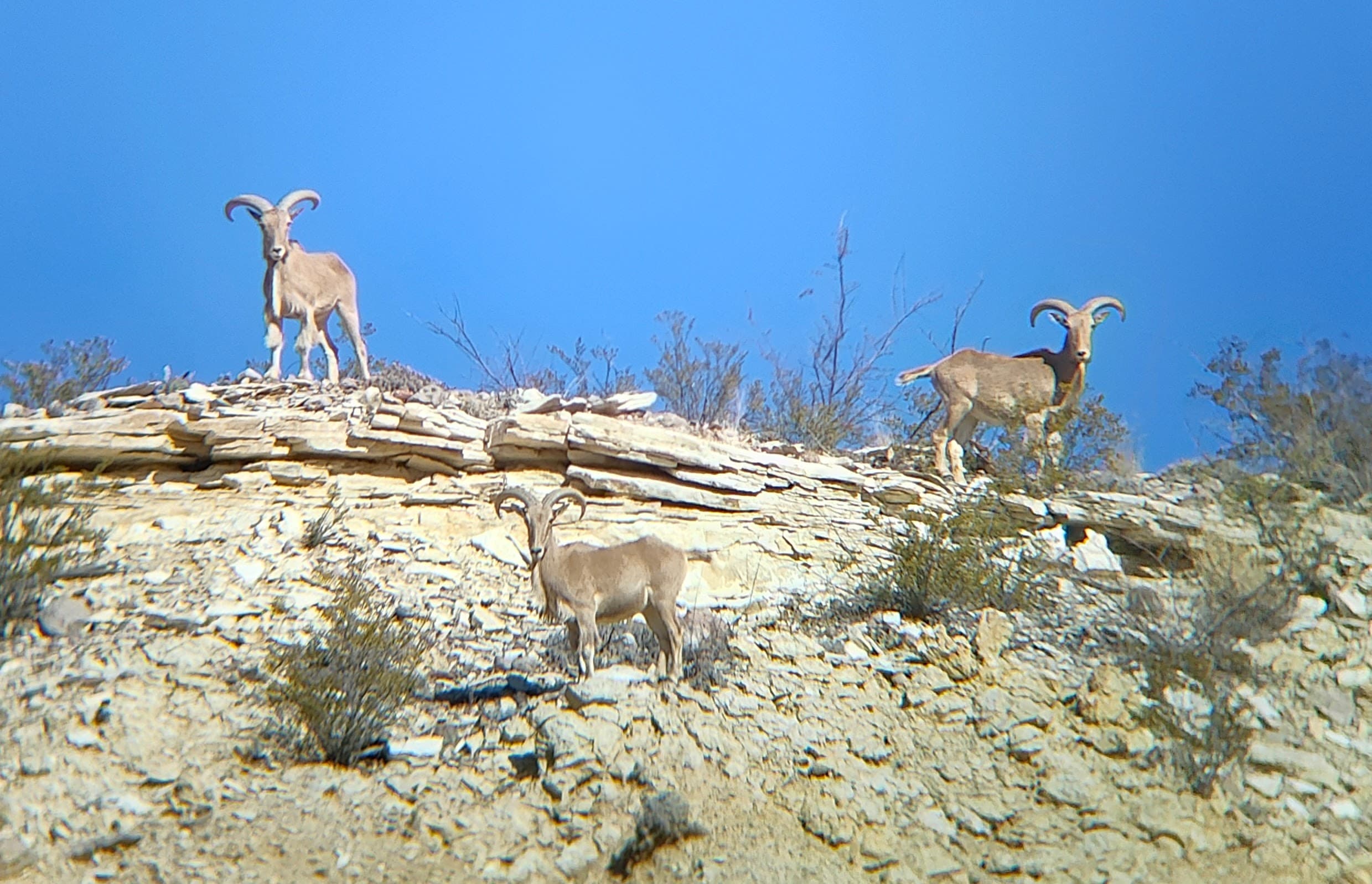
We watched them for several minutes and before heading on our way, I managed to hold my phone up to the monocular and snap a picture. It would have been neat to hunt them, but they weren't actually on the property since they were on the north side of the road that more or less served as the property line. Even if they had been on the property, they were skylining on the top of the ridge and I didn't want to shoot without having a solid backstop. In addition, the only rifle I had with me was in .35 Remington - not exactly a flat-shooting western hunting cartridge. While it actually made more sense in this situation, I had left my late grandpa's "tang safety model" Ruger M77 in .270 Winchester at home. Before the trip, I had been in the middle of swapping out the scope and working up loads for it, and I wasn't comfortable trusting it in the field just yet.
After returning from that trip, I made the decision to get more comfortable with my grandpa's .270. I have been putting in more time with it in the hopes of taking it with me to west Texas this year in a field-ready configuration. It's been a journey with the rifle, trying different things, getting frustrated, then trying other things. The rifle originally had a Weaver K4 fixed 4x scope on it, and one of the first things I did was swap it out for another scope I had, a CV Life 3-9x. My thinking was to put the Weaver on my .360 Buckhammer rifle for close woods work in Big Thicket National Preserve, which would allow me to utilize the higher magnification scope on the .270 for longer shots. The problem, though, was that the CV Life scope didn't have much eye relief. Even with the scope as far rearward as the scope rings would allow, I still had to crane my neck to get into the eye box, and it got worse with higher magnification. Additionally, I had not shot the rifle much before the scope swap and I didn't really have a solid reference for what the recoil should feel like. So, when I began shooting it with the CV Life scope, I just figured that the way it felt was what it was supposed to feel like.
I also spent some time working up loads for the rifle and landed on a couple of different ones. For practice and for east Texas woods work where higher-end velocity and flat trajectory aren't needed as much, I developed a not-quite-full-power load with Hornady 130gr Interlocks and Varget powder. For my west Texas field load, I landed on the Barnes 130gr TTSX and Staball6.5. The interesting thing I learned with that combination is that those Barnes monolithics really like speed. The faster I pushed them, the smaller my groups got. As a result, the limiting factor became safety and functionality, and the final load ended up being near the top end of the published data. Unfortunately, the scope issue still made the rifle uncomfortable to shoot and the recoil made it feel like a shoulder cannon. As a result, I only shot it when I needed to work out a load and came to see shooting it as a necessary evil if I wanted to get serious about taking it to west Texas.
Through this process, I also became interested in other rifle concepts, thinking that perhaps there was a better platform out there for what I wanted to accomplish. At one point, I was on the 6.5x55 Swede bandwagon and spent time looking for an old sporting rifle to carry into the woods. I wanted something that was not quite .270-level power and I figured if it was good enough for the Scandinavians who have been hunting moose and reindeer with it for decades, it ought to work just fine in the east Texas woods. For a time, I also contemplated a 6.5-300 Weatherby, which is perhaps the most overkill and slightly ridiculous solution for my purposes, requiring a 26 inch barrel to push 130gr bullets to over 3,500 fps. None of these ideas ever came to fruition, and perhaps for the better.
My relationship with my grandpa's .270 changed, though, after an unfortunate but fortuitous discovery. Looking ahead to my west Texas trip, I was thinking about the eye relief problem and how to solve it. Part of the problem is that with Ruger rifles, you have to use the proprietary Ruger scope rings, which fit onto the fixed base and only allow for so much adjustment in either direction. In doing some research, though, I came across the Ruger offset rings, which allow for offsetting the scope rings by up to half an inch. Since the limiting factor for the scope placement was that the objective bell prevented the scope from moving further rearward, I figured this could be the solution to my problem. An offset ring would allow me to push it back another half inch so I wouldn't have to crane far forward on the stock when shooting. I was almost ready to buy the offset ring, but wanted to take a couple of measurements first. Unfortunately, or perhaps fortunately, when I pulled the rifle out of the safe, I noticed that the zoom ring wasn't working - the ring wouldn't turn and what little travel it did have didn't affect the zoom in the scope. Troubleshooting the problem, including loosening the lock screw on the zoom ring, didn't yield any results, and I came to the conclusion that the internals had to be damaged. Since it wasn't a particularly expensive scope, I decided to do some research and buy a scope that would specifically fit the rifle without much adjustment.
I eventually landed on a 3-9x Simmons Whitetail Classic scope, which has a generous eye relief of almost 5 inches. This particular scope has actually been discontinued by the manufacturer, but I was able to find one NOS (new old stock) at a discount from a small sporting goods store up in Minnesota and have it shipped. When the scope arrived and I mounted it, I could immediately tell that this was going to be a different experience altogether. When shouldering the rifle, the eye box came up to my eye naturally without any neck craning or straining. Even at max magnification, the eye relief was still very comfortable.
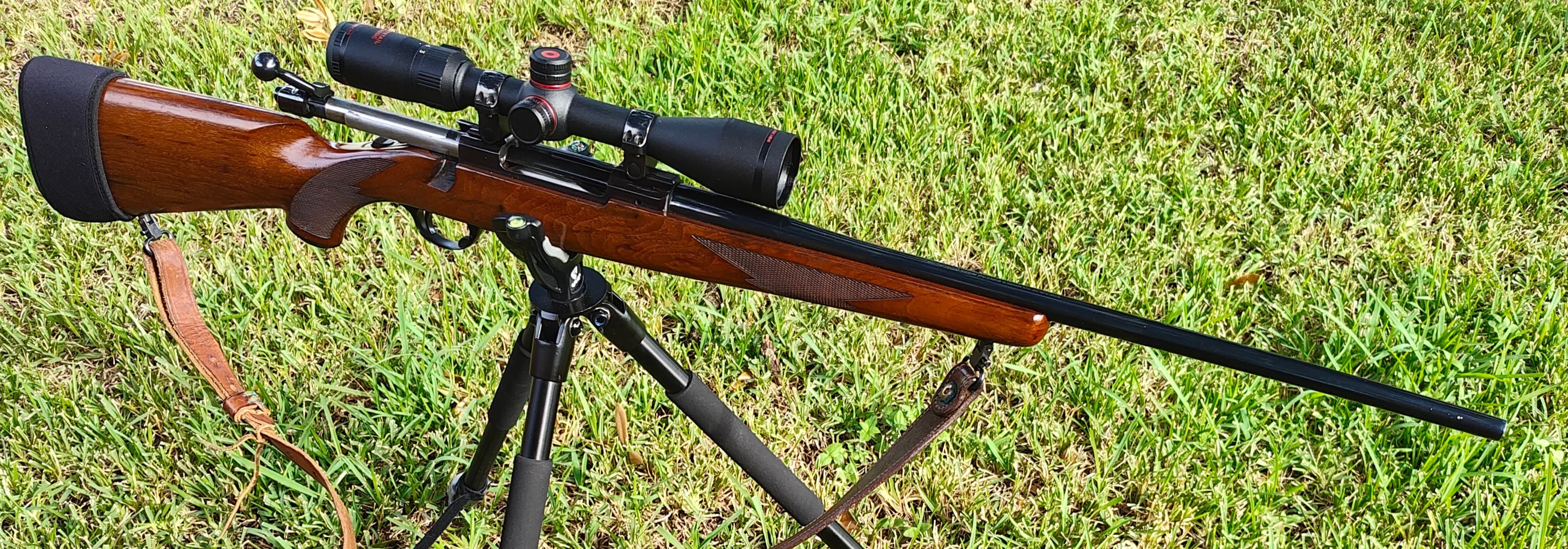
Taking the rifle to the range further solidified that the new Simmons scope was the right call. The recoil suddenly became much more manageable and tolerable. I hadn't realized the impact that contorting and straining to get a good sight picture was having on how comfortable the rifle was to shoot. Even full-power loads suddenly felt much more pleasant and I felt like I could shoot the thing all day if I wanted. And because the sight picture was so much easier to acquire and maintain, I was able to ride the recoil, reacquire the target, cycle the bolt while staying in the scope, and fire again in rapid succession. I got the distinct impression that this was how the rifle was intended - and dare I say, wanted - to be run.
Taking the rifle to east Texas a few weekends ago deepened the relationship further. I made up some softer loads (not "reduced loads" - really just on the lighter end of the published load ranges) just to practice with and maybe even use as light hunting loads. These were using Hornady Interlocks, but my latest idea is to switch these light loads to use Nosler Ballistic Tip projectiles, but more on that later. I practiced shooting the rifle off sticks and even from field positions, such as propping my supporting arm against a tree while standing. Even in field positions, the rifle continued to impress me with just how much easier it was to shoot. And the interesting thing was that when I stopped thinking of the rifle as a shoulder cannon, it suddenly started feeling lighter and handier to carry.
I didn't expect to learn so much about the ergonomics of shooting through this process, and yet I have. And while the journey was frustrating at times, I can't deny that it was yet again consistent with my figuring-it-out ethos. What I do know, though, is that the next time I make it out to west Texas, I will have my grandpa's .270 in tow. And if another three aoudad show up on a ridge, instead of carrying what feels like an unwieldy, special use case rifle, I will have what feels more like a familiar companion.